
Copy updated 6 September 2026. The aircraft is in flight testing. Saab has not published a public test-flight or viewing schedule.
This Gripen F spotting guide starts with a new milestone: Saab completed the two-seat fighter's first flight on 28 August 2026. The aircraft flew from Saab's airfield in Linköping, Sweden, one day before this guide was published.
Fresh first-flight coverage answers what happened. A plane spotter still needs to know what the aircraft looks like, how the Gripen F differs from Gripen E and Gripen D, and what the visible number 4000 means. Those are the field-identification questions this guide is designed to answer.
In short
- Gripen F completed its first 40-minute flight from Linköping at 09:40 local time on 28 August 2026.
- It is the two-seat version of Gripen E and is 0.7 metres longer than the single-seat aircraft.
- The first identification clue is the extended tandem canopy with front and rear cockpits.
- The visible number 4000 is a military aircraft number, not a civil tail registration.
What Saab confirmed about the first flight
In its 28 August first-flight announcement, Saab says Gripen F took off at 09:40 local time and remained airborne for 40 minutes. Saab chief test pilot Jakob Högberg and Brazilian Air Force test pilot Lieutenant Colonel Aviator Abdon de Rezende Vasconcelos flew the sortie.
The flight checked core systems and initial flight performance. Saab says the next phase will expand the flight envelope step by step while evaluating tactical capabilities and functions in the rear cockpit. That wording matters: the first aircraft is a test aircraft, not an operational or delivered fighter.
The first Gripen F was presented in June for Brazil, the launch customer. Saab's 2014 Brazilian contract covers 28 single-seat Gripen E and eight two-seat Gripen F aircraft. Saab also says Thailand and Colombia have ordered the F variant.
How to identify the Saab Gripen F
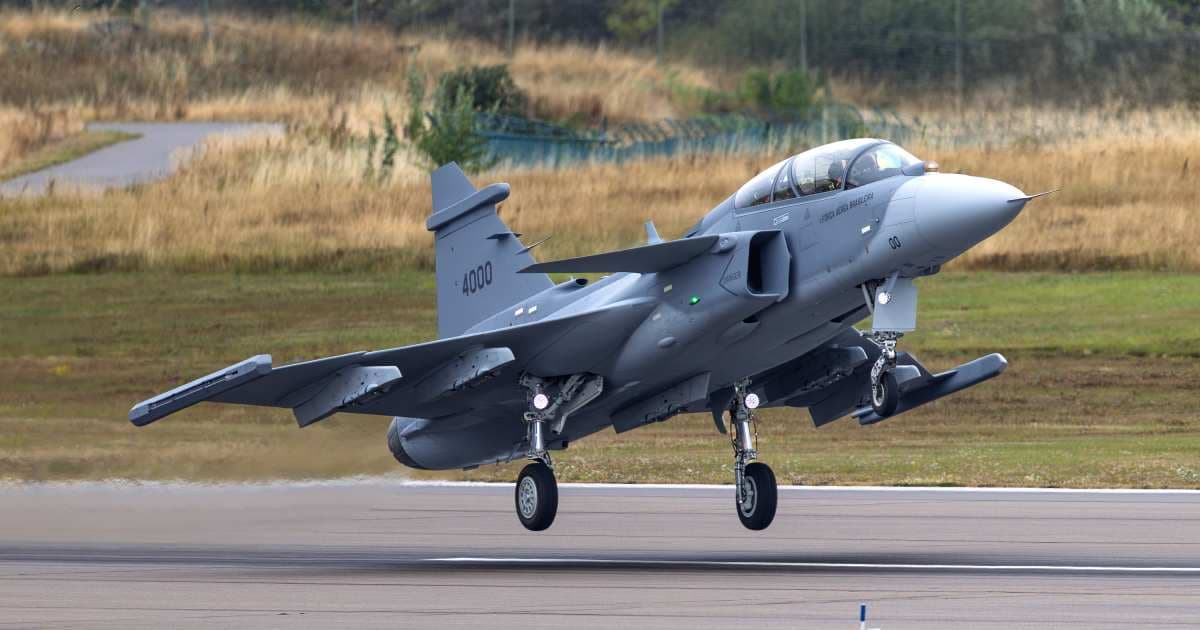
Start with the overall Gripen shape: a single-engine fighter with a cropped delta wing, small canards beside the cockpit, one vertical tail, and side air intakes. Then look for the features that make this aircraft a Gripen F:
- Two-seat tandem canopy: the extended glazed canopy covers a second cockpit directly behind the pilot. This is the clearest F-versus-E clue.
- Longer forward fuselage: Saab lists Gripen F at 15.9 metres, 0.7 metres longer than Gripen E, to accommodate the rear cockpit.
- E-series airframe: the F shares the larger Gripen E-series proportions, wing, canards, single tail, and side-intake layout rather than the earlier C/D-generation airframe.
- Military markings: the first-flight aircraft carries Brazilian Air Force text and the number 4000 on the tail, both visible in Saab's official photograph.
- No single clue in isolation: a tandem canopy also appears on Gripen D. Combine the canopy, E-series proportions, sensor fit, landing gear, and markings.
Gripen F vs Gripen E
The F and E belong to one aircraft system in two versions. Saab's official E-series comparison provides the clearest confirmed differences:
| Feature | Gripen E | Gripen F |
|---|---|---|
| Seats | 1 | 2 |
| Overall length | 15.2 m | 15.9 m |
| Overall width | 8.6 m | 8.6 m |
| Maximum take-off weight | 16,500 kg | 16,500 kg |
| Hardpoints | 10 | 10 |
| Internal Mauser BK27 gun | Yes | No |
For a photograph, the seat count and canopy length do most of the work. The missing internal gun is a manufacturer-confirmed difference, but it is not a dependable long-distance clue. Equal width, weight, and hardpoint count explain why the rest of the silhouette remains so similar.
Gripen F vs Gripen D
The more difficult comparison is with Gripen D because both aircraft have two seats under a long canopy. Gripen D is the two-seat member of the earlier C/D generation; Gripen F is the two-seat member of the newer E/F generation.
- Check the generation: the E/F airframe is larger and uses a revised main-landing-gear arrangement compared with the C/D family.
- Look near the canopy: Gripen E/F imagery shows the newer sensor fit around the forward fuselage, including the IRST position ahead of the canopy.
- Use operator markings: Brazilian F-39 markings on the first Gripen F are stronger evidence than trying to judge a subtle proportion from one angle.
- Verify after the sighting: compare the aircraft number, date, location, and official event or operator listing before assigning the F variant.
A broad Gripen family recognition guide can help with C/D-versus-E/F airframe cues. This article stays focused on the new two-seat F.
Gripen F, JAS 39F, F-39F, and number 4000
Military-aircraft identification uses different labels from civil airline spotting. Keep the aircraft type, operator designation, and visible aircraft number in separate fields:
| Term | What it means |
|---|---|
| Gripen F | Saab's product name for the two-seat Gripen E-series variant. |
| JAS 39F | A common variant search term in the wider JAS 39 Gripen family. |
| F-39F | The Brazilian designation for the two-seat aircraft ordered by the Brazilian Air Force. |
| 4000 | The aircraft number visible on the first Gripen F; it is not a civil registration. |
Do not enter 4000 as though it were a civil registration such as an airline tail number. Record it as the visible military aircraft number, preserve the operator and date, and cite the official Saab first-flight image when verifying the identity.
Where can spotters see Gripen F?
The first aircraft is in a Saab Flight Test Centre campaign in Sweden. Saab has not released a public timetable, route, or daily viewing plan for future test flights. Do not travel on the assumption that yesterday's time or track will repeat.
The dependable opportunities will come from official Saab, Brazilian Air Force, delivery, and airshow announcements. For fighter jet spotting, use public viewing areas at announced events, follow local photography rules, and never enter restricted or operational areas to get a closer image.
Our plane-spotting airport guides can support travel planning when an official appearance is announced, but this guide does not invent a Linköping viewing location or test schedule.
How to verify and record a Gripen F sighting
- Photograph the whole profile: include the tandem canopy, canards, wing, landing gear, and tail when possible.
- Capture the markings: operator text and the aircraft number are stronger than camouflage colour alone.
- Save context: record the date, time, public event or location, and direction of travel.
- Cross-check a primary source: use Saab or the operating air force before relying on a social-media caption.
- Keep uncertainty visible: if the number or generation is unreadable, record Gripen family rather than guessing Gripen F.
FlightCatcherPro is built around identifying aircraft with the camera or a photo you already have, then collecting them. Browse recent aircraft photos from spotters or use our plane spotting guide for beginners for tips on recognising aircraft and recording your sightings.
Following test programmes? The Airbus A350F spotting guide applies the same confirmed-facts and visual-cues approach to a new commercial freighter.
FAQ: Saab Gripen F identification
Has the Saab Gripen F completed its first flight?
Yes. Saab says the first Gripen F took off from its Linköping airfield at 09:40 local time on 28 August 2026 and flew for 40 minutes. It is now in flight testing, not operational service.
How can I identify a Gripen F?
Look first for the long tandem canopy with two cockpits. The Gripen F is also 0.7 metres longer than the single-seat Gripen E. Use the E-series canard-delta shape and aircraft markings to avoid confusing it with another two-seat fighter.
What is the difference between Gripen F and Gripen E?
Gripen F has two seats and is 15.9 metres long; Gripen E has one seat and is 15.2 metres long. Saab lists the same 8.6-metre width, 16,500-kilogram maximum take-off weight, and ten hardpoints, while the F omits the E's internal Mauser BK27 gun.
What is the difference between Gripen F and Gripen D?
Both are two-seat Gripens, so the canopy alone is not enough. Gripen F belongs to the larger E-series airframe and can be checked by its E-series proportions, landing-gear arrangement, sensor fit, and operator markings. Gripen D belongs to the earlier C/D generation.
Where can plane spotters see Gripen F?
The first aircraft is in Saab's test campaign at Linköping, but Saab has not published a public flight timetable or viewing schedule. Use only official airshow, delivery, and operator announcements, and remain in public, permitted viewing areas.
Photograph the aircraft or upload a photo you already have, verify its markings, and add it to your collection with FlightCatcherPro.