
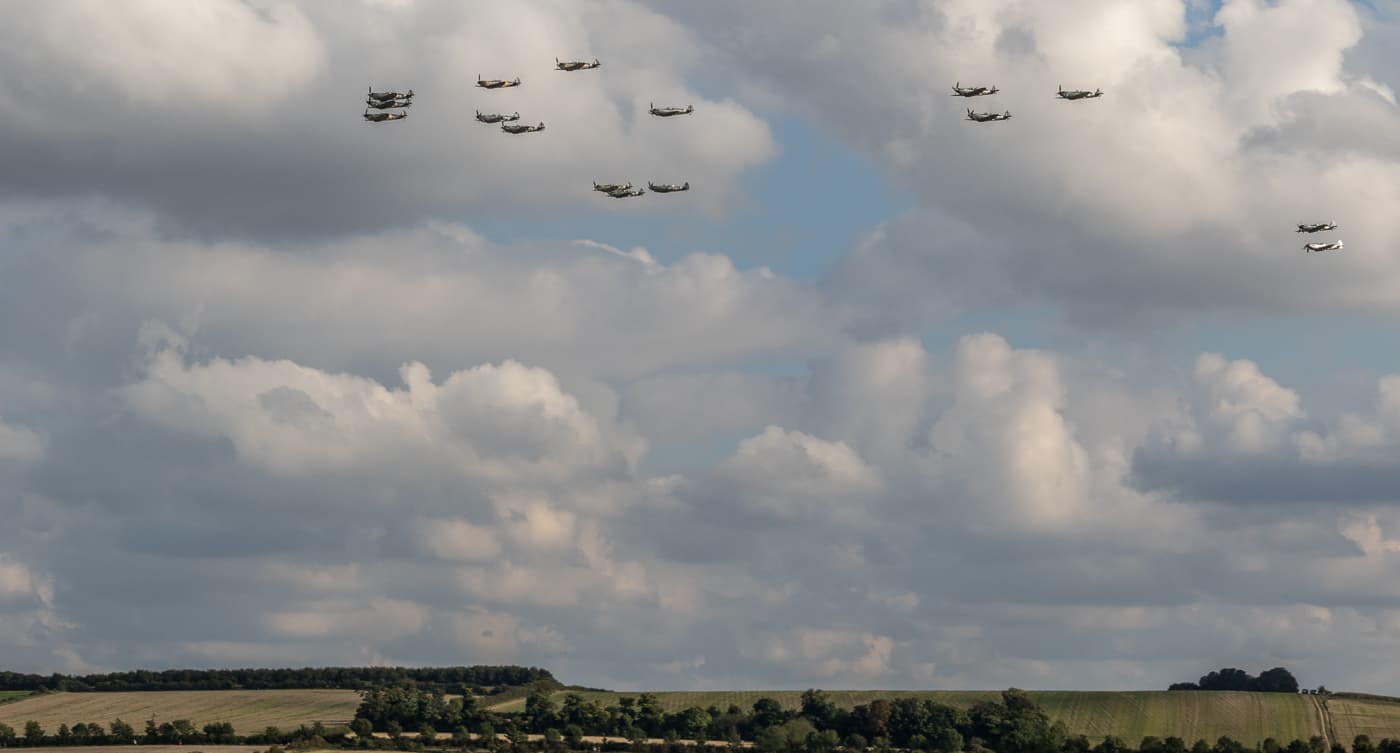
Copy updated 6 September 2026. Photography checklist added 7 September 2026. Flying-list information is based on IWM’s 2 September list, checked on 4 September. Participation remains subject to weather and aircraft serviceability.
The Duxford Battle of Britain Air Show 2026 flying list now covers far more than its headline Spitfire formation. The 12–13 September event brings together the Duxford Big Wing, the Battle of Britain Memorial Flight, rare British and American warbirds, the Red Arrows and a Sunday-only MiG-17F.
Line-up pages tell you what may appear. This guide explains what to look for: which day-specific aircraft matter, which rare types deserve priority, how to separate Spitfires from Hurricanes, and how to record markings without confusing a wartime identity with a modern civil registration.
In short
- The show runs Saturday 12 and Sunday 13 September 2026 at IWM Duxford near Cambridge.
- Red Arrows are Saturday only; the Lim-5/MiG-17F is Sunday only on IWM’s 2 September list.
- IWM names 13 Spitfires, a Seafire and seven Hurricanes, with the final Big Wing count still to come.
- Top rarity targets include Europe’s last airworthy B-17, the oldest airworthy Swordfish and the world’s only flying Blenheim.
Duxford 2026 dates and flying-list status
IWM Duxford hosts the show on Saturday 12 and Sunday 13 September 2026. The official event page says this year marks 90 years since the first flight of the Spitfire and will bring together the largest gathering of Spitfires in the UK during 2026.
The live IWM flying list was updated on Wednesday 2 September. IWM says a final version will be published during the week before the show. It also warns that all flying depends on weather and serviceability, so treat every name below as planned participation rather than a guarantee.
Duxford Battle of Britain Air Show 2026 flying list
This is a compact spotter view of the official list, checked on 4 September. It highlights distinctive aircraft and the features that help you recognise them.
| Group | Aircraft listed | Day note |
|---|---|---|
| Spitfires, Seafire and Hurricanes | 13 individually named Spitfires, Seafire Mk XVII SX336, seven named Hurricanes, the Battle of Britain Memorial Flight and the Duxford Big Wing | IWM has not published the final Big Wing count |
| British aircraft of the Second World War | Avro Anson Mk I, Fairey Swordfish Mk I W5856, Bristol Blenheim Mk If L6739 and Westland Lysander Mk I | Check the final IWM list for any day split |
| American aircraft of the Second World War | B-17 Flying Fortress Sally B, PBY-5A Catalina, three P-51D Mustangs, F8F Bearcat and P-47D Thunderbolt | Listed without a day restriction on 2 September |
| International and Cold War aircraft | Bréguet Br.1050 Alizé, two Hispano HA-1112 Buchóns and a Polish-built Lim-5 representing the MiG-17F | MiG-17F is Sunday only |
| Display teams | RAF Red Arrows and the Duxford-based Flying Comrades in Yak-52 and Yak-18T trainers | Red Arrows are Saturday only |
The list can still gain, lose or move participants between days. Use this page to plan the identification checklist, then use IWM as the final authority before travel and again on the morning of the show.
Saturday vs Sunday: the confirmed differences
Saturday 12 September
The RAF Red Arrows are Saturday only. If the BAE Systems Hawk T1 formation is a priority catch, Saturday is the day named by IWM. The museum says Saturday standard parking has sold out, although the included shuttle from Cambridge Station and Trumpington Park and Ride remains an option for ticket holders.
Sunday 13 September
The Lim-5 / MiG-17F is Sunday only on the latest list. IWM calls this Polish-built aircraft the only airworthy example of its type in Europe, making Sunday the stronger choice for a Cold War jet collector.
IWM says the two daily lists are usually similar, but some aircraft can be day-specific. Do not assume an aircraft without a day label will definitely fly twice; wait for the final list and check for serviceability changes.
Rare warbirds to prioritise at Duxford
The best rare-aircraft checklist is not simply the largest or loudest types. These six aircraft have unusually strong airworthiness claims on IWM’s own list:
| Aircraft | Why it matters | Field clue |
|---|---|---|
| Boeing B-17 Flying Fortress “Sally B” | IWM calls it the last remaining airworthy B-17 in Europe. | Four engines, a broad straight wing, a single tall fin and the UK registration G-BEDF. |
| Fairey Swordfish Mk I W5856 | IWM calls W5856 the world’s oldest surviving airworthy Swordfish. | A large biplane with fixed landing gear, extensive struts and an open-looking crew area. |
| Bristol Blenheim Mk If L6739 | IWM lists L6739 as the world’s only flying example of the type. | A compact twin-engine monoplane with a short nose and twin vertical fins. |
| Westland Lysander Mk I | IWM says it is the only British-built Lysander in airworthy condition. | A high wing, radial engine and large fixed undercarriage spats create an unmistakable outline. |
| Hawker Hurricane Mk IIB BE505 “Pegs” | IWM calls it the world’s only airworthy two-seat Hurricane. | Look for the Hurricane wing and fuselage shape, then the unusual extended two-seat canopy. |
| Lim-5 / Mikoyan-Gurevich MiG-17F | IWM describes this Polish-built aircraft as Europe’s only airworthy example of the type. | A compact swept-wing jet with a circular nose intake. It is listed for Sunday only. |
Also watch the Bréguet Br.1050 Alizé, a rare airworthy French carrier-based anti-submarine aircraft; Seafire Mk XVII SX336, the Royal Navy development of the Spitfire; and the two Spanish-built Hispano Buchóns. The Buchón resembles a Bf 109, but its Merlin installation creates a distinctive deep chin.
Spitfire vs Hurricane: how to identify the Big Wing
The quickest separation is the wing planform. IWM describes the Spitfire by its graceful curves and elliptical wings, while the RAF Museum’s Spitfire and Hurricane comparison contrasts the Spitfire’s elliptical wing and aluminium monocoque with the Hurricane’s traditional wing and framed metal, wood and fabric construction.
| Feature | Spitfire | Hurricane |
|---|---|---|
| Wing from below | Smooth elliptical curve with rounded tips | More traditional straight-tapered planform |
| Fuselage finish | Smooth all-metal monocoque skin | Framed construction with fabric visible aft of the cockpit |
| Overall impression | Slimmer, flowing curves | Deeper, more angular and workmanlike profile |
| Best confirmation | Match the serial or civil registration to the live list | Match the serial or civil registration to the live list |
- Start wide: capture the full underside when the Big Wing passes so the wing shape remains visible.
- Do not count propeller blades first: the show includes several marks and restorations, so blade count changes across the group.
- Do not trust paint alone: restored markings represent different periods and operators.
- Confirm from the serial: use a closer side or tail image after the silhouette has narrowed the family.
Serials, registrations and the Duxford checklist
IWM’s 2 September list names the following Spitfire markings or serials: N3200, AR213, X4650, EP120, JG891, EE602, ML417, PL983, MV293, PS853, PV202, PT462, NH341. It also names Seafire SX336. The Hurricane list names P3717, P2902, R4118, V7497, BE505, AE977, P3700.
Those visible historic identities are not always the aircraft’s current civil registrations. For example, Sally B uses the UK civil registration G-BEDF, while Swordfish W5856 is presented by its military serial. A complete spotting record keeps the displayed identity, current registration, aircraft type, date and operator in separate fields.
Browse FlightCatcherPro’s aircraft registration photo galleries to see how registrations connect sightings of the same aircraft. If a historic marking and modern registration conflict, preserve both instead of replacing one with a guess.
A practical Duxford airshow spotting plan
- Book before travelling: IWM says no tickets are available on the day, online or at the gate.
- Arrive for the flightline: the official plan-your-day page says included flightline access remains open until approximately noon.
- Choose one day-specific target: Red Arrows on Saturday or the MiG-17F on Sunday.
- Make a short rarity list: prioritise three to six airframes rather than trying to identify every aircraft in a large formation at once.
- Capture context: save a wide silhouette, a close marking, the display group and the time.
- Use the official showground: follow event staff, security boundaries and photography rules; never enter operational or restricted areas for a closer image.
New to the hobby? Start with our plane spotting guide for beginners and use the airport spotting guide directory for future trips. For a modern military-aircraft comparison, the Gripen F identification guide shows why markings matter as much as silhouette.
Duxford airshow photography: a phone identification checklist
A useful spotting photograph preserves the clues you will need later. At the Battle of Britain show, a formation photo can record the moment beautifully while leaving individual serials unreadable. Use this checklist alongside the flying list for the 12–13 September weekend. It is a suggested recording workflow, not a guarantee that every aircraft will be close enough to identify with a phone.
- Keep the whole aircraft in one frame. Leave space around the wings and tail. A tight crop of a roundel loses the wing shape that helps separate a Spitfire from a Hurricane.
- Take a second photograph for markings. When an aircraft is nearby and access permits, capture the side and tail. Keep the original photograph as well as any crop. Enlarging a distant blur cannot recover a serial the camera never recorded.
- Record the display context. Note the day, time and announced group in your phone’s notes. For a formation, record which aircraft you mean: left, right or leader. The programme helps narrow candidates, but does not prove which individual you photographed.
- Check detail before the next pass. Review one image at full size. If the aircraft is too small or blurred, aim for a clear formation or silhouette record rather than claiming a registration. A nearby parked aircraft may provide a better chance to record markings, from the areas open to visitors.
- Separate observation from identification. Write down the letters you can actually read. Compare the aircraft type, displayed wartime identity and current registration separately. Leave an uncertain match unconfirmed; a restored paint scheme alone is not enough to identify an airframe.
After the show, follow our guide to identifying an aircraft from a photograph to work through the visual clues. For ambiguous tail markings, use the aircraft registration guide before saving a confirmed record in FlightCatcherPro.
FAQ: Duxford Battle of Britain Air Show 2026
Can I photograph and identify Duxford warbirds with a phone?
A phone is useful for nearby aircraft and formation photographs, but distant aircraft may not show enough detail for a reliable identification. Save a full-aircraft view, a separate close view of any readable markings, and the display time. Compare those clues with the programme; keep an uncertain identity unconfirmed rather than guessing a registration.
When is the Duxford Battle of Britain Air Show 2026?
The show is at IWM Duxford near Cambridge on Saturday 12 and Sunday 13 September 2026. IWM says the site is open from 8am to 7pm on both days.
What is on the Duxford Air Show 2026 flying list?
The official list checked on 4 September includes the Duxford Big Wing, multiple Spitfires and Hurricanes, the Battle of Britain Memorial Flight, B-17 Sally B, Swordfish, Blenheim, Lysander, Catalina, three P-51D Mustangs, Alizé, two Buchóns, Red Arrows and a Sunday-only MiG-17F. Weather and serviceability can change the list.
Are the Red Arrows at Duxford in September 2026?
Yes. IWM lists the Red Arrows for Saturday 12 September only. The MiG-17F is the clearly marked Sunday-only participant on the 2 September list.
What time does flying start at Duxford Air Show 2026?
IWM confirms that the site opens at 8am and the included flightline access runs until approximately noon, but the official pages checked on 4 September did not publish a final flying timetable. Check IWM’s live event information before travelling.
How can I tell a Spitfire from a Hurricane?
Use the wing first: a Spitfire has a smooth elliptical planform, while a Hurricane has a more traditional straight-tapered wing. In close photographs, the Spitfire’s all-metal fuselage is smoother and the Hurricane’s framed, fabric-covered rear fuselage can show more texture. Confirm the serial because marks and restored paint schemes vary.
Can I buy Duxford Air Show tickets at the gate?
No. IWM says entry is advance-ticket only and no tickets are sold on the day online or at the gate. Parking also has to be booked, while a free shuttle is available from Cambridge Station and Trumpington Park and Ride.
Photograph the aircraft or upload a photo you already have, verify its markings, and save them to your collection with FlightCatcherPro.